
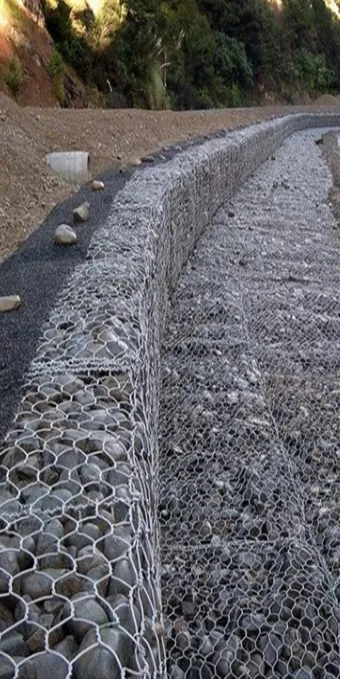
Why Prefill and Lift Gabions
Conventional gabions are assembled and filled at their final position. That is efficient on accessible dry sites, but it becomes difficult during short tidal windows, emergency flood response, underwater repair, remote work, or closures where every hour matters. Prefilling allows units to be assembled, filled, closed, and inspected on a stable platform before rapid placement. It can improve stone control and reduce labour exposure at the final location. The concept also introduces major handling loads. A normal basket is not automatically safe to lift when full; the unit and lifting method must be engineered together.
What Makes a Unit Liftable
The design must control the path from stone weight to the crane hook without overloading mesh wires, diaphragms, lids, or connections. Depending on the project, this may involve an external lifting frame, spreader beam, reinforced internal ties, dedicated lifting interfaces, restraints, or a reusable cage. The unit's dimensions and stone grading affect deformation and balance. Dry mass, submerged mass, dynamic effects, crane radius, sling angles, weather, current, and handling cycles all matter. A trial unit and trial lift are strongly recommended before production placement. Lifting should follow an approved plan prepared by competent personnel.
Information Required before Manufacture
The manufacturer needs unit drawings, required mesh and coating, fill grading and density, maximum filled mass, prefilling location, transport route, lifting equipment, rigging concept, placement depth, current or wave exposure, foundation preparation, final connections, tolerances, and applicable safety requirements. If units will travel filled, transport restraint and road or barge loads also need review. Marine environments require coating selection for salinity, wet-dry cycling, UV, and abrasion. Underwater placement may need survey, diver, sonar, or remotely operated verification because visual control is limited.
Typical Applications
Prefilled gabions can accelerate emergency breach closure, flood-bank repair, scour-hole reinstatement, culvert and bridge protection, shoreline and quay works, pipeline or cable protection, and remote crossings. They can be staged near a quarry, stockpile, barge, or crane pad, then placed in a planned sequence. Units may be connected after placement to create continuous protection. The method is not automatically cheaper than flat-pack installation; its value comes from access, safety, time, quality control, and the ability to work in conditions where conventional filling is impractical.
Quality and Method Controls
Inspect mesh, reinforcement, closures, lifting components, stone fill, and deformation before every lift. Confirm that loose rock cannot escape and that the center of gravity matches the rigging plan. Keep records of unit identity, filled mass, inspection, and placement position. Stop work when wind, current, visibility, equipment, or damage exceeds the method limits. After placement, verify orientation, bearing, joints, and connections. For permanent works, include the same lifecycle inspections used for other gabion protection, with extra attention to lifting interfaces and any deformation caused during handling.
Working with Zhongman
The Prefilled Liftable Gabion for Rapid Installation page is the commercial entry point for these enquiries. Zhongman can manufacture reinforced units and project accessories after the lifting and placement concept is defined. Send the method drawings and handling data rather than requesting a price per ordinary basket. We can support trial manufacture, labelling, packing, and a production schedule, while the contractor and project engineer retain responsibility for lifting design and site execution.