
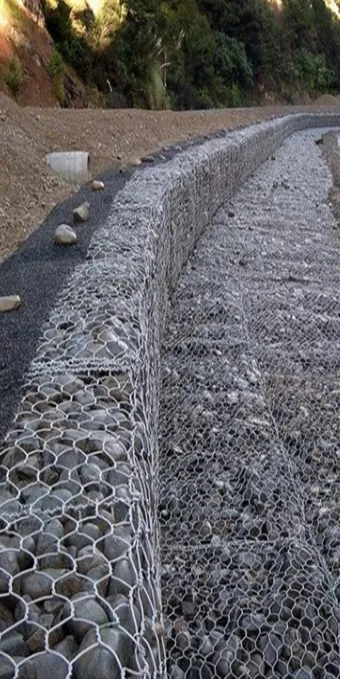
What a Gabion Check Dam Does
A gabion check dam is a permeable grade-control structure built across a gully, drain, or small watercourse. Its purpose is not to create a large reservoir. It reduces the energy slope, slows runoff, captures sediment, and prevents head-cut erosion from moving upstream. Stone-filled mesh is useful because it combines mass, roughness, permeability, and flexibility. A series of modest structures is often more effective and maintainable than one oversized barrier. The design still requires hydraulic and geotechnical judgment: drainage area, peak discharge, sediment load, channel width, bank material, foundation conditions, and downstream consequences determine whether gabions are appropriate and how the system should be sized.
Site Selection and Spacing
Choose a stable reach where the dam can key into both banks and bear on competent material. Avoid placing the structure where flow can easily bypass an erodible flank. In a series, a common grade-control concept is to position the crest of each downstream dam near the elevation of the upstream dam's toe, creating a stepped hydraulic profile. This is a starting concept rather than a universal formula. Steeper channels, weak banks, flashy catchments, and high sediment loads may need closer spacing, wider aprons, or additional bank protection. Survey the longitudinal profile and cross-sections before ordering baskets so every structure has a defined crest, foundation, and tie-in elevation.
Crest, Wings, Foundation and Apron
The center overflow section is normally lower than the keyed wings so routine flow stays away from the banks. Foundations should extend below loose bed material, and the ends should embed securely into both sides. Where falling water can scour the toe, provide a downstream Reno mattress or gabion apron long enough to cover the predicted impact and turbulence zone. Upstream cutoffs or filters may be needed to control piping. The dam body must have enough width and mass for sliding and overturning stability. Large drops, deep flows, or important infrastructure require engineered calculations rather than rule-of-thumb basket stacking.
Mesh, Coating, Filter and Stone
Specify double-twisted mesh, wire diameter, coating, basket dimensions, diaphragm spacing, and lacing in a coordinated schedule. The mesh opening must retain the selected rock, including smaller pieces near the faces. Coating selection depends on abrasion, water chemistry, wet-dry cycling, UV exposure, temperature, and required durability. A geotextile or graded filter is often needed beneath and beside the structure to stop fine soil migrating through the rock voids. Fill should be hard, durable, angular enough to interlock, and resistant to weathering. Weak shale, rounded undersized stone, contaminated demolition waste, and highly variable grading can shorten service life or produce excessive settlement.
Construction and Quality Checks
Prepare the bed and bank keys first, then assemble baskets square and connect every adjoining edge. Install diaphragms and internal bracing before filling. Place stone in controlled lifts, hand-position visible faces where appearance matters, and maintain the spillway profile. Close and lace lids without leaving loose edges. Confirm that the apron, cutoffs, bank keys, and filter remain continuous. Record unit dimensions, wire and coating documents, stone source, and photographs before the structure is submerged or backfilled. Early inspections after the first significant storms are especially important because they reveal bypass flow, toe scour, settlement, debris blockage, or an undersized overflow section.
Ordering a Complete System
For an accurate quotation, send the channel survey, structure schedule, design flows, drop heights, foundation notes, filter requirements, stone grading, coating specification, and delivery sequence. Zhongman can manufacture check-dam baskets, Reno mattress aprons, lacing, bracing, and compatible accessories as one labelled package. The product page Gabion Check Dam System for Channel Erosion Control lists the commercial ordering parameters. Final hydraulic sizing and stability remain the responsibility of the project designer.