
When to Use a Mattress Lining
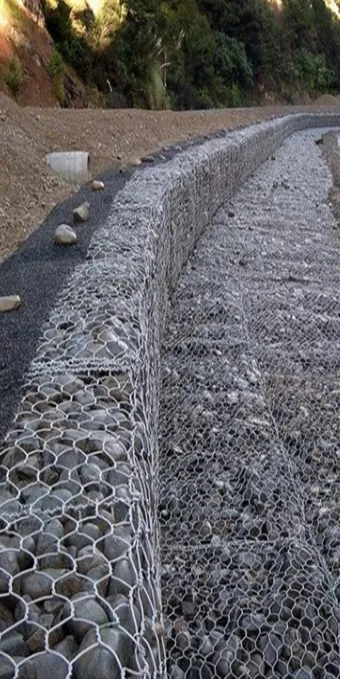
Reno mattresses are thin stone-filled mesh units used to protect channel beds and side slopes against erosive flow. They are considered where an unlined channel cannot resist the design shear stress, loose riprap would be unstable or difficult to grade, and a flexible permeable surface is preferable to rigid concrete. Applications include stormwater channels, irrigation canals, spillways, roadside drains, mine watercourses, and river-training works. Suitability depends on hydraulic loading, sediment and debris, subgrade, available stone, access, durability requirements, and consequences of failure. A mattress is an engineered revetment, not simply a shallow gabion basket.
Hydraulic and Geometric Inputs
The designer needs channel cross-sections, longitudinal slope, design discharge, flow depth, velocity or boundary shear, bends, transitions, drops, structures, and expected debris or sediment. These determine lining extent, mattress thickness, stone grading, side-slope coverage, toe and crest details, and the need for energy dissipation. Bends and transitions often experience higher local stress than a uniform straight reach. Upstream and downstream terminations must be protected so flow cannot get beneath the lining. Where calculations predict uplift, rapid drawdown, or high turbulence, the filter and anchorage details become as important as the surface armour.
Stone, Mesh and Coating
Select durable rock that resists weathering and abrasion. The grading must suit the mattress thickness and remain securely inside the mesh, including smaller particles near exposed faces. Mesh opening, wire diameter, diaphragm spacing, and coating should be stated together. Double-twisted mesh offers continuity if an individual wire is damaged. Heavy galvanized, Zn-Al alloy, and polymer-coated systems serve different exposure levels; water chemistry, wet-dry cycling, UV, abrasion, and required design expectations guide the choice. The supplier should not reduce wire or coating to meet a target price without formal approval.
Filter, Cutoffs and Connections
Permeable stone armour still needs a soil-retention strategy. A graded granular filter or compatible geotextile prevents fine subgrade particles washing into the mattress voids while allowing drainage. Fabric must survive installation and remain continuous at overlaps and structure interfaces. Cutoffs or buried edges at the inlet, outlet, toe, and crest reduce undermining. Lace all adjacent mattresses and connect bed and side-slope units so the lining acts continuously. Transitions to concrete, culverts, unlined soil, or heavier gabions should be drawn explicitly; vague notes create gaps on site.
Construction and Maintenance
Trim the subgrade to line and level, compact soft areas, place the filter, and assemble units without dragging them across the fabric. Stretch and align mattresses, connect diaphragms and edges, fill evenly, and close lids firmly. Avoid large voids, segregated rock, and unsupported panels. Inspect after significant flows for edge scour, exposed filter, local settlement, broken wire, loose lids, displaced stone, debris, vegetation that blocks capacity, and erosion beyond the protected reach. Repair problems early and extend protection if channel migration or a changed outlet concentrates flow outside the original design.
Specifying and Buying the System
Use the product page Gabion and Reno Mattress Channel Lining System for enquiry and future paid-search traffic. A useful RFQ includes drawings, hydraulic basis, unit schedule, mesh and coating requirements, rock grading, filter, accessories, quantities, and construction sequence. Zhongman can label flat-pack bundles by reach or chainage and combine mattresses, toe baskets, lacing, and geotextile in one shipment.